Indianapolis summers are hot, and a hot day plus stop-and-go traffic is how a weak cooling system shows itself. The National Weather Service's normal July high is in the mid-80s, with a handful of 90-degree days in a typical July and more in a hot summer. A cooling system that is a little low on coolant, or running with a worn part, can cope in April and boil over in July.
How the cooling system works, in plain words
Coolant, a mix of antifreeze and water, absorbs heat from the engine. The water pump moves it through the engine and out to the radiator, where air flowing through the fins cools it. A thermostat decides when coolant flows to the radiator, a fan pulls air through when the car is not moving, hoses carry the fluid, and a pressure cap keeps the system sealed so the coolant can run hotter without boiling. If any one of those parts fails, the engine temperature climbs.
Why summer traffic finds the weak spots
At highway speed, air is forced through the radiator. In stop-and-go traffic, a slowdown on the beltway or a long line of cars, the car depends on its fan and on having enough coolant. Air conditioning adds heat at the front of the car, and a heavy load or a trailer takes away more margin. That is why a car can run fine on the open road and overheat in traffic.
What to do when the temperature gauge climbs
- Turn off the air conditioning. Turn the heater to full heat and the fan to high. That pulls heat away from the engine. It is uncomfortable, and it can buy you time to get off the road.
- Pull over somewhere safe as soon as you can and shut the engine off. Do not keep driving with the gauge in the red.
- Do not open the hood right away, and never open the radiator cap on a hot engine. The system is under pressure and hot coolant can spray out.
- Let the engine cool completely. That takes a while, and your owner's manual may give a time.
- When it is cool, look at the coolant reservoir. If it is low, add coolant up to the level marks. Low coolant means a leak somewhere, so the car still needs a look.
- If it overheats again, or you see steam or a coolant puddle, stop and call for help or a tow.
The reason to stop is the engine. Driving an overheated engine can cause serious damage, including a damaged head gasket, and a cooling repair is far cheaper than an engine repair. How soon a mechanic can come depends on availability, and we do not offer emergency dispatch or roadside service.
Want a price for your car?
Text us what you need. Nearby independent mechanics bid. You see the first bid, and a later one only if it is lower. You pay when the work is done.
Common causes of overheating
- Low coolant from a leak: a hose, the radiator, a water pump seal, a loose clamp or the reservoir. Look for puddles, dried residue near hoses, or a sweet smell.
- A thermostat stuck closed: coolant never gets to the radiator. A thermostat replacement is a common fix.
- A fan or fan relay that does not run: the car overheats in traffic but not at speed.
- A clogged or damaged radiator: blocked inside by deposits or outside by debris.
- A worn water pump: a leak, a noise or a loose pulley.
- A weak radiator cap: it cannot hold pressure, so the coolant boils sooner.
- A head gasket leak: the serious one. White exhaust smoke, milky oil or repeated overheating after the coolant is topped up are warning signs, and the engine usually needs a shop.
A mechanic finds the cause with a pressure test and a look at the parts, not by guessing. See a car is overheating inspection and our cooling system repair guide for Indianapolis.
Check it before the heat arrives
- With the engine cool, check the coolant level in the reservoir.
- Squeeze the hoses when cool. They should feel firm, not mushy, cracked or bulging.
- Look under the car for drips and around the hoses for dried residue.
- Keep the front of the radiator clear of leaves and debris.
- Follow the coolant change interval in your owner's manual. A radiator flush can be done where the car is parked.
- Watch the temperature gauge. A reading that is higher than usual is the first warning.
Heat is hard on the rest of the car too
AAA says summer heat does more damage to batteries than winter cold, and that a heat-weakened battery is far more likely to fail once the weather cools. That is the battery that will not start your car in January. Our no-start guide covers what happens then. Tires gain pressure as they warm, so check pressure when they are cold. An air conditioner that blows warm is a repair like any other, and a mechanic can check it where the car is parked.
Where the repair happens
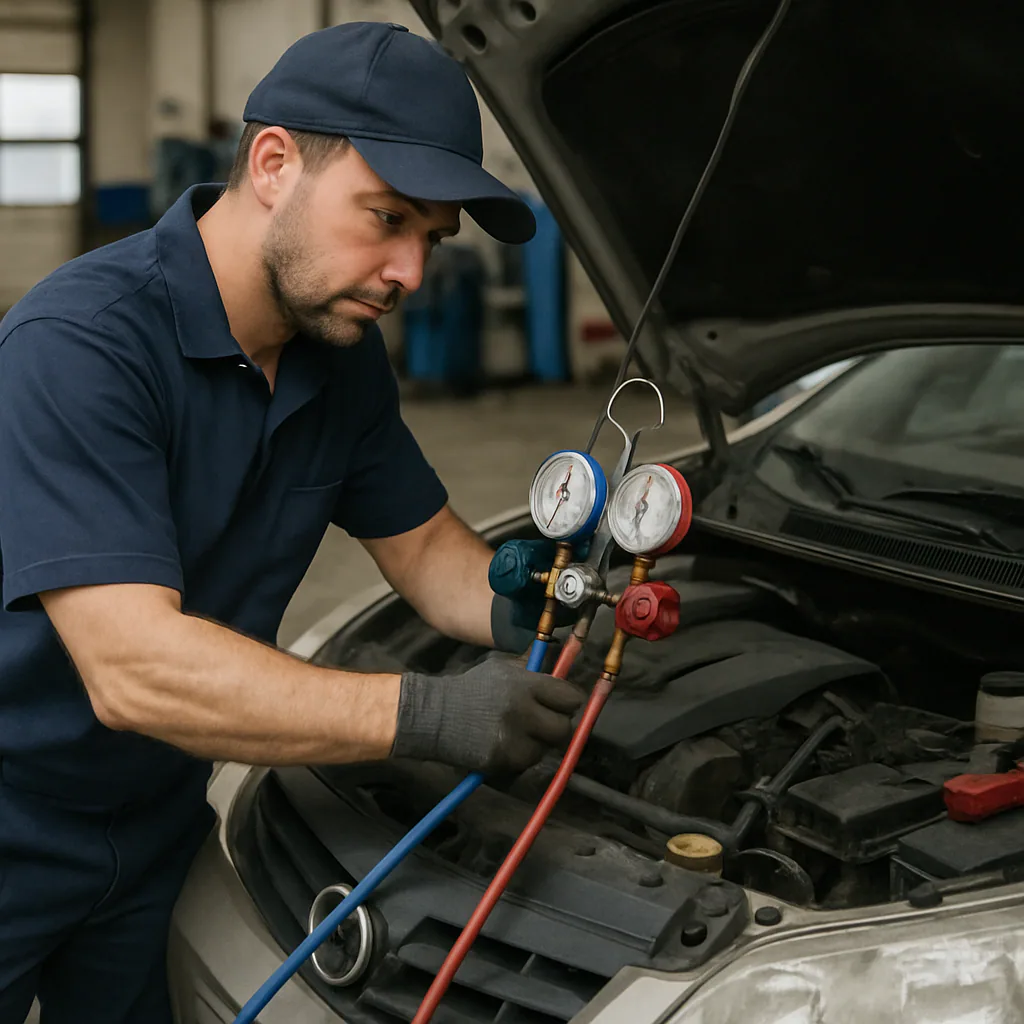
A mobile mechanic can pressure-test the system and replace hoses, a thermostat, a radiator, a cooling fan or a water pump in your driveway, garage or parking lot. A shaded spot or a garage helps in July. If the engine has already been damaged by overheating, it may need a shop, and the mechanic will tell you. Get free quotes before the next heat wave. Our diagnostics guide covers warning lights and what a scan can and cannot tell you.